
What Does Proposal Software Actually Cost?
How AI proposal tools charge in 2026, what drives cost differences between drafting-first and workflow-first platforms, and how to evaluate whether public per-seat pricing fits your team's proposal volume.
See the proposal builder
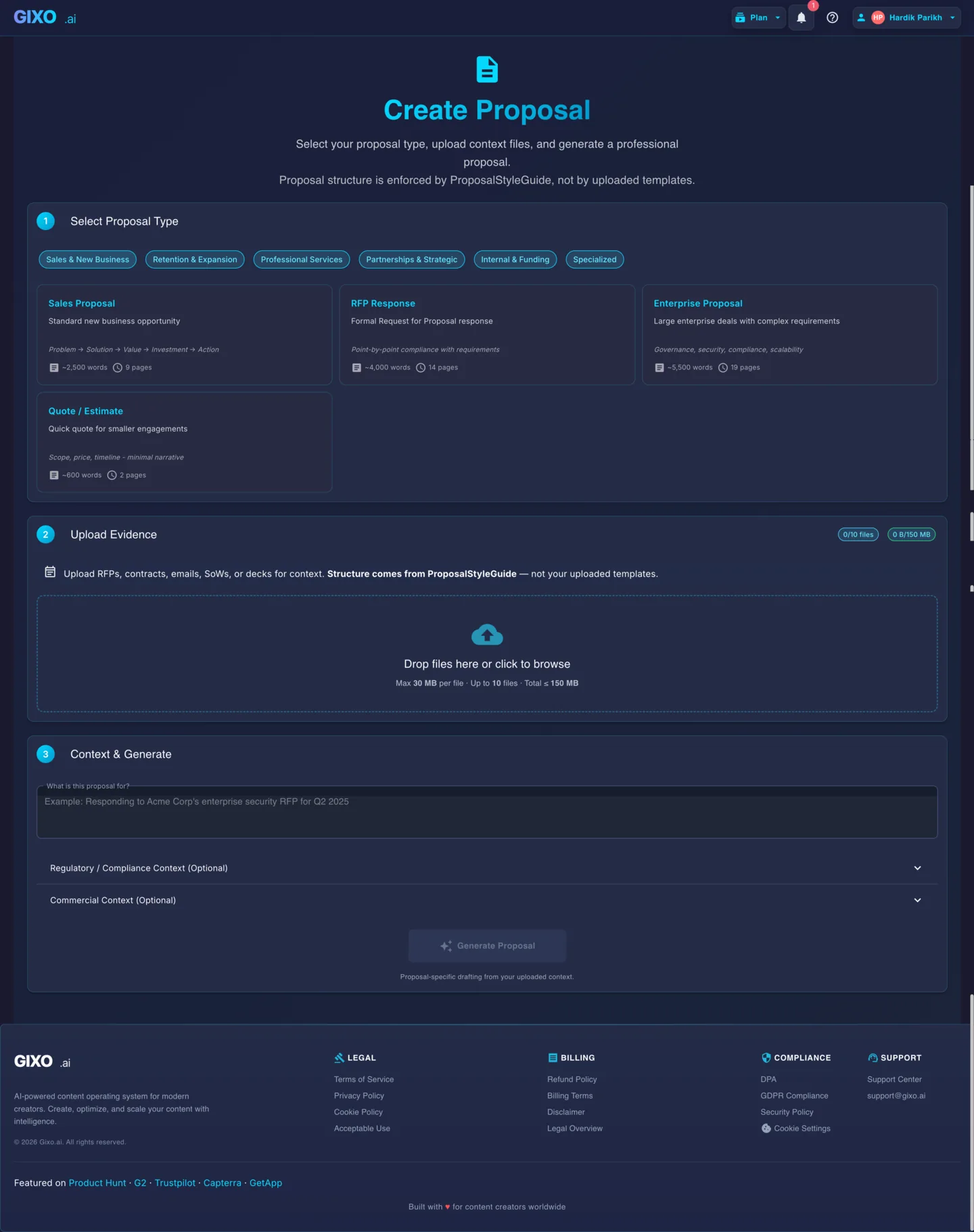
Pick the proposal type, upload your files, add the missing context, and make a first draft in one place.
Common Pricing Models for AI Proposal Software
AI proposal tools fall into three billing models. The right choice depends on how many proposals you draft, how many people touch each one, and whether you need send-and-track alongside drafting.
Fixed monthly or annual fee per user. Common among workflow-first platforms like PandaDoc and Proposify that bundle templates, e-signatures, and analytics. Predictable cost for teams with steady headcount, but scales linearly regardless of actual proposal output.
Pay per proposal generated, per credit consumed, or per AI call. Lower entry cost for teams that draft in bursts — responding to RFPs quarterly rather than weekly. Cost can spike during busy bid seasons if not capped. Some AI drafting tools use this model for bursty workloads.
Negotiated annual contract with unlimited or high-cap usage. Typically includes onboarding, SLAs, content libraries, and custom integrations. Platforms like Loopio and Responsive target enterprise RFP teams with this model. Usually requires annual commitment and minimum seat counts.
What Drives Cost Differences
Beyond the billing model, these factors create the spread between a $25/month drafting tool and a $500/month proposal ops platform.
Drafting-first tools like Gixo focus on turning source files and context into a strong first draft. Workflow-first tools like PandaDoc add templates, e-signatures, tracking, and CRM integrations. More workflow surface area means higher cost per seat.
Enterprise RFP platforms charge more because they maintain large answer libraries, knowledge bases, and compliance content that gets reused across proposals. Drafting tools that work from uploaded source files do not carry this storage overhead.
Proposal tracking — open rates, time spent per section, viewer engagement — adds cost. If your bottleneck is the first draft rather than post-send analytics, you may not need this layer and can save by choosing a drafting-focused tool.
Pricing Approach Comparison
How pricing models compare across the kinds of products teams usually evaluate for AI proposal work.
| Factor | Workflow-first suite | Design-first suite | Interactive proposal tool | Gixo Proposals |
|---|---|---|---|---|
| Pricing structure | Per-seat workflow pricing | Per-seat design workflow pricing | Per-seat web proposal pricing | Product-based, per-seat pricing |
| Primary focus | Send, track, and sign | Styled proposal creation and review | Interactive web proposals | AI drafting from source files |
| Evaluation path | Check current vendor demo or trial | Check current vendor demo or trial | Check current vendor demo or trial | 14-day free trial |
| Source-file drafting depth | Usually secondary | Usually secondary | Usually secondary | Core product behavior |
| Delivery features | Often built in | Often built in | Often built in | Handled outside the drafting product |
| Best fit | Teams centered on send-and-sign workflow | Teams centered on proposal polish | Teams centered on web-native proposals | Teams centered on better first drafts |
| Budget shape | Driven by headcount and workflow scope | Driven by headcount and design workflow scope | Driven by headcount and delivery workflow scope | Driven by seat count and proposal workflow choice |
Evaluation Checklist Before You Buy
Is your team slow at drafting the first version, or slow at sending, tracking, and following up? Drafting-first tools solve the former. Workflow platforms solve the latter. Paying for both when you only need one wastes budget.
Per-seat pricing favors high-volume teams where the cost per proposal drops with scale. Usage-based pricing favors teams that draft a few proposals per month or respond to RFPs in irregular bursts.
If your proposals require synthesizing RFPs, technical specs, past deliverables, and client briefs into a coherent draft, prioritize tools that handle source file upload and context extraction. Template-first tools assume you already have the content ready.
A $50/month drafting tool that cuts first-draft time from 8 hours to 2 hours saves more than a $200/month platform that only reduces formatting time. Factor in your team's blended hourly rate when comparing subscription costs.
How Gixo Proposals Is Priced
Gixo Proposals uses product-based, per-seat pricing. Start with the 14-day trial, then keep paying only for the proposal drafting workflow you actually use.